
Nightmare Surrogacy Cases: McKenna West | Part 1: The Legal Overview - How We Got Here

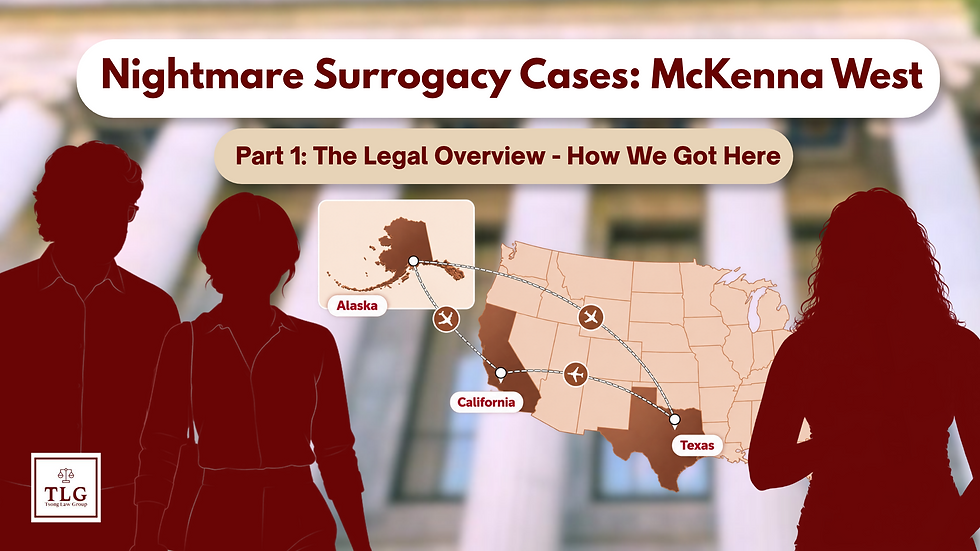
On September 22, 2026, a high-profile multistate surrogacy dispute in the United States came to an end, at least for now. Justice Elena Kagan denied an emergency application from McKenna West, an Alaska gestational carrier who had asked the U.S. Supreme Court to halt a California judgment recognizing Nausheen Gilkar and Omar Ahmed, the California intended parents, as the legal parents of the child West delivered in Texas. The denial came without an opinion, leaving the lower-court rulings in place, including the California parentage judgment and the Texas rulings permitting the child to be transferred to California for medical treatment.
What Happened
In August 2025, West entered into a gestational surrogacy agreement with Gilkar and Ahmed to carry and give birth to their genetically related child through assisted reproduction. The surrogacy agreement provided that the intended parents could request and West would comply with an abortion request if the intended parents requested one for abnormalities. On April 17, 2026, when West was approximately 20 weeks pregnant, an ultrasound revealed that the fetus had hypoplastic left heart syndrome (HLHS), a serious congenital heart condition. According to the parties' court filings and testimony, Gilkar and Ahmed asked West to terminate the pregnancy. West refused. By mid-July, she had moved without permission to Texas, where abortion is generally prohibited. On August 12, West gave birth in Texas to the child the intended parents named Rumi and West has referred to as Gabriel.
In the span of less than a year, West and the intended parents moved from a surrogacy arrangement to litigation in multiple courts and three states, with each side asking courts to give legal effect to a different part of their understanding of the arrangement.
The Whole Three-State Legal Saga
California: Parentage Judgment
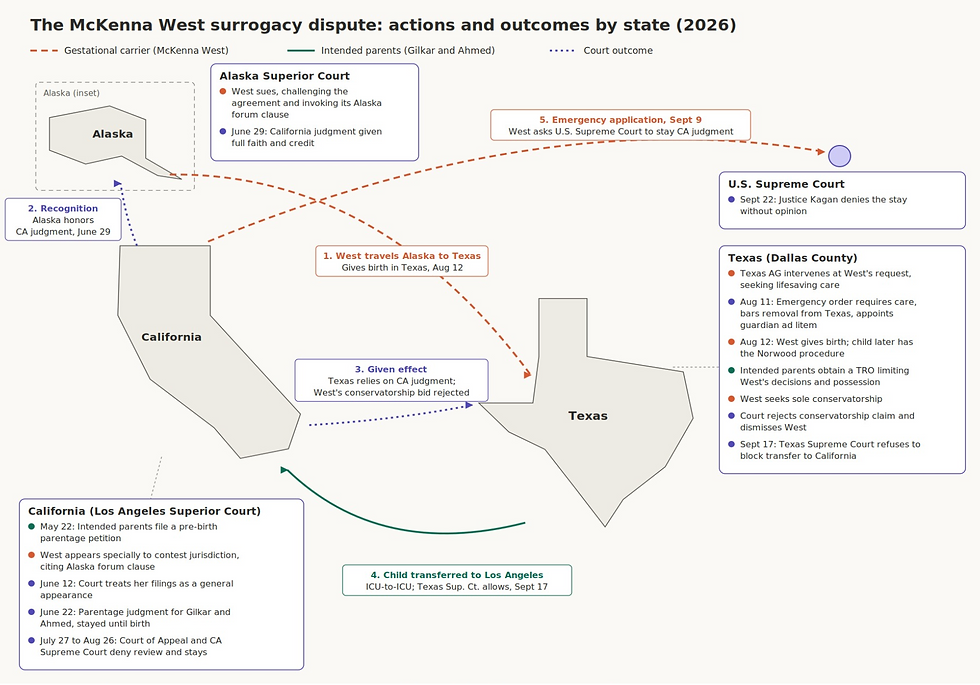
On May 22, 2026, Gilkar and Ahmed, as California residents, filed a petition with the Los Angeles Superior Court seeking a judgment establishing their parentage of the unborn child. California law expressly permits an action to establish the parent-child relationship for a child conceived through a gestational-carrier agreement to be filed before birth. Under California Family Code § 7962, when presented with a petition and a surrogacy agreement that complies with California law, a court shall issue a judgment finding that the intended parents are the parents of the gestated child and the gestational carrier is not a parent of the child.
West made a special appearance to contest California's jurisdiction and the forum and moved to quash service. Her position was that California was not the proper forum for the dispute, pointing in part to the agreement's Alaska forum-selection provision. The California trial court rejected that threshold challenge. According to West's September 9 Supreme Court filing, the court concluded on June 12 that West's jurisdictional filings constituted a general appearance, which the court treated as consent to its jurisdiction. The court subsequently entered a judgment of parentage on June 22, declaring Gilkar and Ahmed the legal parents. The judgment was stayed until the child's birth.
West appealed the judgment and separately sought writ relief and a stay from the California Court of Appeal. Those petitions were denied between July 27 and August 7. On August 7, she petitioned the California Supreme Court for review and a stay; that request was denied on August 26.
The California proceedings therefore established two facts that became central to legal proceedings that were pursued afterwards: California had entered a parentage judgment before the child's birth, and West had exhausted her available challenges to that judgment in the California courts before turning to the U.S. Supreme Court.
Alaska: honors CA parentage judgment
Alaska was the forum contemplated by the parties’ agreement and the state where West lived. The parties also previously initiated a joint parentage proceeding there before the dispute moved to California.
After the California action was filed, West brought her own action in the Alaska Superior Court, McKenna West v. A.B. et al., No. 3AN-26-07180 CI. In her Alaska complaint, West challenged provisions of the surrogacy agreement and argued that portions of the agreement were unenforceable under Alaska law and the Alaska Constitution. She also relied on the agreement's forum-selection provision in challenging the move to California.
On the other hand, intended parents have independent basis under California law to seek a parentage judgment there, and the California judgment was also entitled to recognition in Alaska under the Full Faith and Credit Clause of the U.S. Constitution, Article IV, § 1. On June 29, the Alaska Superior Court gave the California parentage judgment full faith and credit. That result illustrates an important separation between a contractual choice of forum and interstate recognition of a judicial judgment. A provision selecting Alaska as the forum for contractual disputes did not necessarily determine which state could exercise statutory jurisdiction over parentage, nor did it by itself prevent another state’s final judgment from receiving recognition under the Full Faith and Credit Clause of the U.S. Constitution.
Texas: Medical Decision-Making
Before the birth, Texas Attorney General Ken Paxton intervened in the Dallas County proceeding at West's request for judicial protection. Paxton's office sought an emergency order requiring that the newborn receive medically necessary, lifesaving treatment and remain in Texas while the court considered the parties' competing claims. His filing framed the issue separately from the enforceability of the surrogacy agreement: the immediate question, in the Attorney General's view, was whether a newborn with a serious but potentially treatable heart condition could be denied lifesaving care because of a dispute among adults concerning parental authority.
On August 11, the intended parents obtained a temporary restraining order preventing West from making medical decisions, taking custody of the child, representing herself as a decisionmaker, parent or guardian for the child, one day before West gave birth.
On the same day, the Dallas court granted AG Paxton’s request for an emergency order which required the hospitals to provide lifesaving care after the child's birth and restricted his removal from Texas while the matter remained pending. It also appointed a guardian ad litem for the child and provided for further judicial intervention if medically necessary treatment were refused. These orders provided Baby Rumi receive care and West not have a role or any access to Baby Rumi but did not resolve whether Gilkar and Ahmed, rather than West, had parental authority and the ability to make medical decisions.
After the child was born, he received treatment in Texas, including the Norwood procedure. AG Paxton subsequently withdrew from the case. The temporary restraining order obtained by Gilkar and Ahmed remained in place, however, limiting West's ability to make medical decisions, exercise possession of the child, or remove him from the hospital.
The Texas proceedings then shifted from emergency medical protection to the parties' competing claims of parental authority. West sought sole conservatorship of the child and argued that she should have a legal role in protecting and making decisions for him. On September 2, the Dallas court ultimately rejected West's claim and dismissed her from the proceeding. West's subsequent appeal and reporting on the proceeding indicate that the court gave effect to the existing California parentage determination rather than treating the child's Texas birth as creating a new parentage question.
The medical question nevertheless remained. Because the child was born with HLHS and required complex cardiac treatment, the intended parents sought to transfer him to Los Angeles for continued specialized treatment, while West sought to prevent the intended parents from transferring him from Texas to California. At an August 25 hearing, the Texas court heard evidence from the child's physicians and from a court-appointed guardian ad litem concerning the proposed transfer who favored the transfer, and the court approved the transfer and converted the temporary restraining order to a temporary injunction.
West appealed, and the appeal delayed the transfer of the child to California. The matter eventually reached the Texas Supreme Court. On September 17, that court denied West's request to prevent the transfer. The court emphasized the time-sensitive medical circumstances and the child's immediate interests, stating that the limited record before it contained uncontroverted medical testimony that an ICU-to-ICU transfer was in the child's best interest to preserve his life. The court's reasoning rested primarily on the medical record and the child's immediate welfare, rather than on a new rule concerning the enforceability of surrogacy agreements.
Taken together, the proceedings in the McKenna West case produced a series of rulings, rather than a single definitive answer to every issue raised by the dispute.
California’s judgment rested on its statutory framework for gestational-carrier agreements under Family Code § 7962. That framework reflects California’s longstanding recognition of intended parents in gestational surrogacy, including the principles articulated in Johnson v. Calvert, 5 Cal. 4th 84 (1993).
Alaska’s recognition of the California judgment added an interstate dimension, but did not independently resolve the underlying dispute over the surrogacy agreement. Texas, in turn, addressed the circumstances after the child’s birth, including emergency medical care, conservatorship, and transfer to California.
U.S. Supreme Court: Emergency Application
On September 9, after the California Supreme Court denied her request for review and a stay, West filed an emergency application with the U.S. Supreme Court. She asked Justice Elena Kagan, who handles emergency applications arising from the Ninth Circuit, to stay the California parentage judgment while she pursued further review and to preserve her ability to seek relief concerning the child.
The constitutional question presented was narrower than the underlying surrogacy dispute. West argued that the California court had violated the Due Process Clause of the Fourteenth Amendment by treating her limited appearance to contest personal jurisdiction and forum as a general appearance consenting to California's jurisdiction. In her telling, she had expressly appeared only to challenge the court's authority over her; the California court instead concluded that her challenge in the court amounted to a consent to its jurisdiction.
On September 22, Justice Kagan denied the application without an accompanying opinion. The order left the California judgment and the relevant Texas rulings in place, but it did not constitute a merits decision by the full Supreme Court on the enforceability of surrogacy agreements or interstate parentage.
In the end, the outcome of the case seems like it was never in doubt with all the court decisions in favor of the intended parents, but this likely could have ended up differently had the intended parents given up at some point and not been willing to fight tenaciously for their parentage and ability to make medical decisions. It appears that Gilkar and Ahmed had to rely on their own funds to litigate and defend the various court actions. In West’s case, her lawyers were provided by anti-abortion group Alliance Defending Freedom, which took on the Dobbs litigation that overturned Roe v. Wade, and was supported by a GiveSendGo campaign that raised over $135,000.
The legal victory for the intended parents only restored them to what the parties had agreed to in their contract: the status of legal parents who have the exclusive right to name the child, be on the birth certificate, and make medical decisions for the child. One can only wonder if West’s appeals, which delayed the transfer of the child to a high-level ICU in California, adversely affected the health outcome of Baby Rumi.
For surrogacy professionals, there is a very important positive development in the legal saga: the courts of Alaska and Texas consistently held that a surrogacy parentage judgment from another state had to be afforded full faith and credit. Secondly, even though the forum selection clause indicated Alaska was the proper forum for parentage, a contested parentage judgment was obtained in California and recognized by all three states. The fact that two states’ courts recognized the California parentage judgment, even though contested by the surrogate, could strengthen the certainty of parties to enforce surrogacy contracts in other states which have no surrogacy laws or even a negative law like Arizona, where a parentage judgment could be obtained in a different state.
As the legal proceedings were a long and winding discussion, we plan to have a part two article on the West case. In our next part, we will discuss what practical lessons can be learned from the matter.
The McKenna West case shows how a surrogacy journey can take unexpected turns. Careful planning and honest discussion with your surrogacy lawyer can help intended parents and gestational carriers understand their rights and responsibilities before those turns become disputes.
Tsong Law Group specializes in assisted reproduction law across the United States, with attorneys licensed in California, New York, Washington, Arizona, Oklahoma, and Illinois. We help intended parents and gestational carriers navigate every stage of the legal process, from pre-birth orders to parentage judgments. If you're building your family through surrogacy, contact our team to schedule a consultation.



Comments